Table of Contents
Who Was Allama Iqbal?
Allama Iqbal (1877–1938) was a lawyer, poet, philosopher and political thinker whose written words molded the modern Muslim and evoke them to do rational discussions in South Asia. He was born on 9 November, 1877 in Sialkot and died on 21 April 1938. His views on Muslim identity, Islam, and the Seal of Prophethood further strengthened the resolve of Muslims to stand against falsehood and seek a deeper understanding of their true purpose.
Section sources: Iqbal Academy / International Iqbal Society, biography and chronology; dates corroborated by Iqbal Academy UK.
Allama Iqbal on Qadianism: The Background
During the 1930’s the Qadiani controversy was one of the most heated religious debates in Punjab. Mirza Ghulam Ahmad Qadiani held beliefs about Finality of Prophethood that many Muslim scholars rejected as contrary to the doctrine of the Finality of Prophethood. Opposition movements, the Majlis-e-Ahrar-ul-Islam campaigned publicly against the Qadiani community. Opposition movements also pushed their stance and the debate spread into newspapers, mosques and political gatherings. Readers interested in learning more about the founder of the Qadiani movement can refer to our article on Mirza Ghulam Ahmad Qadiani. For further insight into the movement and the views of one of its prominent critics, readers may also explore our article on Pir Meher Ali Shah and the Qadiani movement.
Allama Iqbal was asked to speak on the issue because of his standing as a scholar and public intellectual. The question was raised simply not because of one’s personal belief: it emphasized how the boundaries of the Muslim community were understood by everyone, particularly in relation to the Finality of Prophethood and how attacking those boundaries affect the Muslim collective identity. On 14 May 1935 Iqbal’s important public statement, “Qadianism and Orthodox Muslims” was published in The Statesman, Calcutta. This came after a debate, about the Qadiani movement and a public call for Muslims to take a stand in the disagreement. The Nehru Archive shows that Jawaharlal Nehru read Iqbal’s article and later discussed its meaning in his writing.
Section sources: Iqbal Academy, chronology (entry for 14 May 1935); Nehru Archive, “The Solidarity of Islam” (20 August 1935); Teena Purohit, “Muhammad Iqbal on Muslim Orthodoxy and Transgression” (2015).
How His Views Developed
Iqbal’s position on the Ahmadiyya movement should be understood chronologically rather than presented as unchanged throughout his life. In his 1911 lecture, The Muslim Community: A Sociological Study, he made a favourable observation about the Qadiani movement in the context of Muslim character in Punjab. However, when the lecture was subsequently published, an explanatory note dated 21 October 1935 indicated that his earlier assessment needed reconsideration in the light of movement’s subsequent developments.
Iqbal himself acknowledged this change in his response to criticism, recalling that approximately twenty-five years earlier he had hoped the Ahmadiyya movement might produce beneficial results. However, as its direction became clearer, his position changed, particularly because of its claims concerning prophethood and its treatment of other Muslims as Kafir. This historical record does not support the assertion that Iqbal opposed the movement from its inception, nor does it establish that he was ever formally associated with it.
An important distinction emerges from Iqbal’s letter dated 7 April 1932, in which he expressed sympathy for certain members of the Lahore Ahmadiyya group, describing them as Muslims possessing a sense of honour. The Lahore Ahmadiyya group who regarded Mirza Ghulam Ahmad as a religious reformer (Mujaddid) and Promised Messiah, but not a prophet, upheld Muhammad (PBUH) as the final prophet, and recognised other Muslims who professed the Kalima regardless of their acceptance of Mirza Ghulam Ahmad. These doctrinal differences help explain Iqbal’s distinction between the Lahori and Qadiani groups of Ahmadiyya community. Although Iqbal appreciated the Lahori group’s position on the Finality of Prophethood and its recognition of other Muslims, he did not agree with their interpretations of the Mahdi, Messiah or religious reformers. Iqbal believed that their beliefs have been influenced by Persian and other non-Arab cultural and philosophical ideas rather than being firmly established in the original teachings of Islam which are backed by Quran and Hadith.
These statements are part of the documentary record and should not be collapsed into a single, simplified account of Iqbal’s position.
Section sources: Iqbal, “The Muslim Community: A Sociological Study” (lecture delivered 1911; later explanatory note dated 21 October 1935); Iqbal’s rejoinder to The Light, reproduced in Thoughts and Reflections of Iqbal, pp. 297–298; Iqbal Nama, Part II, letter dated 7 April 1932, pp. 230–232. The early chronology is also discussed by Teena Purohit (2015).
The 1935 Nehru – Iqbal Debate on Islam and Ahmadiyya Community
Jawaharlal Nehru answered Iqbal’s ideas by writing three articles in The Modern Review in Calcutta in 1935. The Nehru Archive has a document called “The Solidarity of Islam” that is dated 20 August 1935. It also has another document named “His Highness the Aga Khan” that is dated 21 August 1935. A third article titled “Orthodox of All Religions Unite” was published in the December 1935 issue. This information is included in the account that appears in the Islamabad High Court judgment in the case of “Allah Wasaya, v Federation of Pakistan”.
Nehru questioned how Iqbal argued about unity related to the variety of religions found across the Muslim world. He also questioned what it meant to set limits around religious beliefs. Iqbal answered with an essay called Islam and Ahmadism. It was published in the journal Islam in Lahore in January 1936 according to history books and academic sources. Sometimes the title is wrongly said to be, from 1935. The discussion started in 1935. The answer is usually thought to have been written in January 1936.
In his essay Islam and Ahmadism (1935 – 36), Iqbal articulated his mature and critical position on the Qadiani movement, arguing that its claims concerning prophethood were incompatible with the Islamic principle of the Finality of Prophethood (Khatm-e-Nabuwwat). He also examined the Lahore Ahmadiyya group’s distinction between regarding Mirza Ghulam Ahmad as a religious reformer and Promised Messiah rather than a prophet. While appreciating its affirmation of the Finality of Prophethood and recognition of other Muslims, Iqbal retained reservations about their interpretations of the Mahdi, Messiah and religious reformers. He viewed the wider controversy as having implications for Muslim identity, unity and political solidarity in British India. Although he advocated separate recognition of the Qadiani community from the rest of the Muslims. He explicitly rejected coercive state interference in religious matters.
Section sources: Nehru Archive, “The Solidarity of Islam” (20 August 1935) and “His Highness the Aga Khan” (21 August 1935); *Allah Wasaya v Federation of Pakistan*, PLD 2019 Islamabad 62; Iqbal chronology; Purohit (2015).
Iqbal’s Principal Arguments in Response to Nehru’s Critique
In the essay, Iqbal presented the Oneness of God (Tauheed) and the Finality of Prophethood (Khatm-e-Nabuwwat) as the two fundamental principles of Islam. He regarded these not as secondary religious details but as the defining foundations of Muslim identity and the social cohesion of the Ummah. In his understanding, the belief that Prophet Muhammad (PBUH) is the final prophet meant that no claimant to prophethood after him could introduce a new religious authority whose acceptance became a condition of remaining within Islam. Iqbal considered the claims of Prophethood attributed to Mirza Ghulam Ahmad to be a challenge to this principle
Iqbal closely linked the Finality of Prophethood with the unity of Muslims. He argued that a claim to prophethood after Prophet Muhammad (PBUH), especially one requiring other Muslims to accept its authority, would lead to the formation of a separate religious community with its own beliefs and identity. In his view, this would weaken the common bond that united the Muslim Ummah. Therefore, Iqbal saw the issue not simply as a religious disagreement but as a question of who constituted the Muslim community and what beliefs held it together. He made it clear that he was not advocating the forcible suppression of the Ahmadiyya movement. Instead, he considered non-interference in religious matters an appropriate policy for the government of India. At the same time, he argued that the Ahmadiyya community should be recognized separately from other Muslims for political, religious and constitutional purposes.
Section sources: Iqbal, “Islam and Ahmadism” (published in Islam, Lahore, January 1936; reproduced by the International Iqbal Society). Particularly relevant are the discussion of the two propositions of Islam and the postscript on non-interference and separate community status.
Letter to Nehru
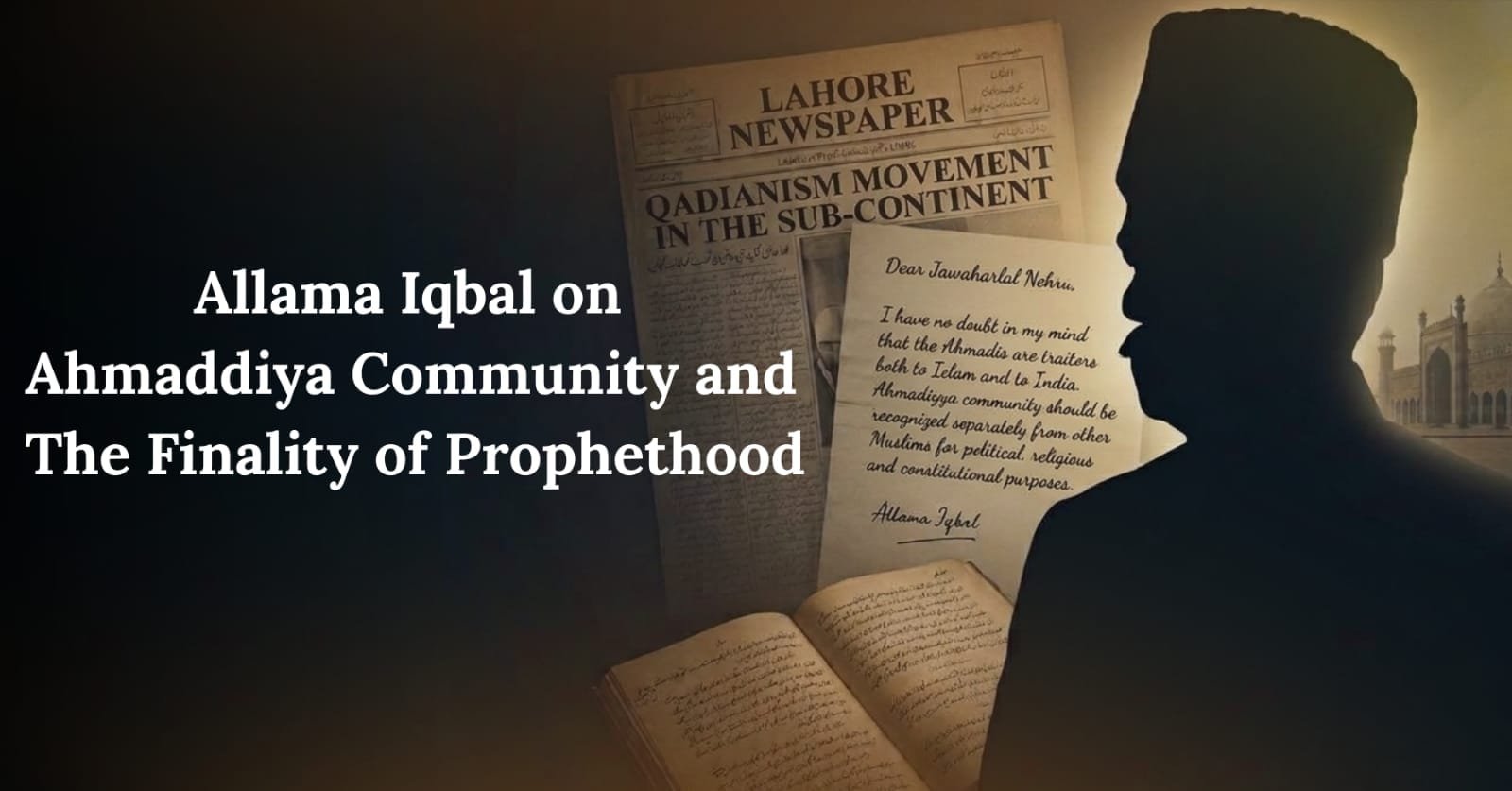
In a letter written to Nehru dated 21 June 1936, Iqbal clarified that his earlier essay, Islam and Ahmadism, was intended to explain the historical background and political implications of the Ahmadiyya movement. He initially believed Nehru was unaware of the movement’s political position. He also noted that some Muslim readers had interpreted Nehru’s articles as expressing sympathy for the Ahmadiyya movement.
One of the strongest statements in the letter reads:
“I have no doubt in my mind that the Ahmadis are traitors both to Islam and to India.”
This was Iqbal’s own strongly expressed judgement in the context of the controversy, not an independently established historical fact. He further explained that, despite having little personal interest in religious debates, he had addressed the subject to challenge the movement’s arguments and explain their wider implications.
The letter provides valuable insight into Iqbal’s intentions and his response to Nehru’s criticism. It should be read alongside Islam and Ahmadism for a fuller understanding of his position.
Source: Letters of Iqbal, compiled and edited by Bashir Ahmad Dar, Iqbal Academy Pakistan, 2021 edition, pp. 161–162. Read Letters of Iqbal (PDF)
From Iqbal’s Writings to the 1974 Constitutional Amendment
Iqbal’s writings have since been cited in Pakistan in discussions about the religious and constitutional status of the Ahmadiyya community. The Second Amendment to Pakistan’s Constitution was enacted in September 1974; it amended Articles 106 and 260 and inserted a constitutional definition concerning the Finality of the Prophethood of Muhammad (PBUH). That amendment declared the Qadiani community non‑Muslim. Supporters of the amendment often point to Iqbal’s writings as part of the case, for it. The Qadiani and Lahore Ahmadiyya communities have their own interpretations of Iqbal’s statements and contest some of the ways in which they have been presented or interpreted. Readers should therefore consider these perspectives alongside Iqbal’s original writings and correspondence when examining the historical record.
Section sources: Constitution (Second Amendment) Act, 1974; Teena Purohit (2015); Iqbal’s own writings distinguishing the Qadiani and Lahori groups.
Why This Matters Today
Reading Iqbal’s statements in chronological order helps distinguish his original words from later slogans, selective quotations and interpretations. His writings reveal how his position developed over time, while consistently emphasising the Finality of Prophethood and the close connection between religious identity and Muslim unity. Anyone seeking to understand Iqbal’s views on Ahmadiyya community should begin with his article Qadianis and Orthodox Muslims, followed by Islam and Ahmadism, and then his letter to Jawaharlal Nehru dated 21 June 1936. Reading these sources together provides a clearer understanding of his evolving position and the historical context in which he expressed it.
Frequently Asked Questions
What did Allama Iqbal say about Qadianism?
Allama Iqbal’s views on Ahmadiyya Community evolved over time. In his later writings, particularly Islam and Ahmadism (1935–36), he strongly challenged its claims concerning prophethood as incompatible with the Finality of Prophethood (Khatm-e-Nabuwwat). In his letter to Nehru dated 21 June 1936, he expressed his position in particularly strong terms, stating: “I have no doubt in my mind that the Ahmadis are traitors both to Islam and to India.”
What was Iqbal’s reply to Nehru?
Iqbal replied to Nehru’s articles through his essay Islam and Ahmadism, published in January 1936. He defended the Finality of Prophethood as a fundamental Islamic principle, arguing that the Qadiani movement’s claims challenged Muslim identity and unity. While advocating non-interference in religious matters, he also called for the Ahmadiyya community to be recognized separately from other Muslims for political, religious and constitutional purposes.
Where can I read “Islam and Ahmadism”?
You can read Allama Iqbal’s Islam and Ahmadism: With a Reply to Questions Raised by Pandit Jawaharlal Nehru online through the following sources:
Iqbal Cyber Library: Read the original 1936 publication. The catalogue identifies the original Lahore edition, published by Anjuman-i-Khuddam-ud-Din in 1936, comprising 47 pages.
References
- International Iqbal Society, “Speeches, Writings & Statements of Allama Iqbal”: authoritative contents list for Part Three and the separate 21 June 1936 letter. Source
- International Iqbal Society, “Islam and Ahmadism”: primary text, including the postscript and Iqbal’s argument on finality and communal identity. Source
- International Iqbal Society, “The Muslim Community – A Sociological Study”: earlier lecture and later explanatory note on his changing assessment. Source
- Iqbal Academy, chronology – publication date of “Qadianism and Orthodox Muslims” (14 May 1935) and biographical chronology. Source
- Nehru Archive, “The Solidarity of Islam” (20 August 1935) and “His Highness the Aga Khan” (21 August 1935): Nehru’s contemporary texts. Source
- Teena Purohit, “Muhammad Iqbal on Muslim Orthodoxy and Transgression: A Response to Nehru”, ReOrient 1:1 (Autumn 2015), pp. 78–92: peer-reviewed academic context. Source
- Constitution (Second Amendment) Act, 1974: statutory text. Source